
Wednesday, 15 August 2012

SOMEONE HAS BUILT IT BEFORE

ON ARCHITECTURE


The inescapable power of architecture

In an extract from his new book, our architecture critic deconstructs the mysterious ways in which buildings shape our lives
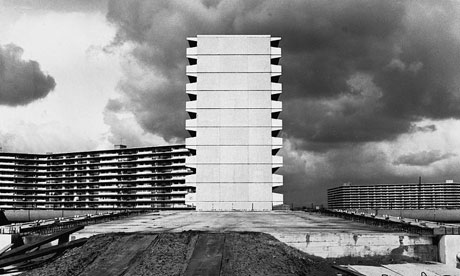
Bijlmermeer housing development amsterdam
'Obsessively planned': the Bijlmermeer complex during construction in 1970. Photograph: Pieter Boersma
An architect used to tell a story. Invited by a couple to design an extension to their house, he dined with them, listened to their needs and desires, heard his and her versions of what they wanted. At the end of the evening, he gave his professional advice. "You don't need an extension," he said, "you need a divorce."
  1. Why We Build
  2. by Rowan Moore
  3. Buy it from the Guardian bookshop
  1. Tell us what you think:Star-rate and review this book
It is advice that could have saved the software entrepreneur Larry Dean tens of millions of dollars. Dean is a man who grew up in a house without indoor plumbing, overcame his early poverty and went on to become a millionaire many times over. In 1992, he and his wife, Lynda, completed the biggest house in Atlanta, Georgia, a mansion of 32,000 square feet, the colour of salmon mousse. According to its architect, Bill Harrison, each square inch of it was given the attention to detail of "a Fabergé egg". The interiors were designed by their son, Chris, then a design student aged 21. The Deans' dream, it would later be reported, "was to raise their four children here in an atmosphere like Dynasty, only happy".
It is hard to do justice to the extravagance ofDean Gardens, as it was called, and the promiscuity of its inspirations and appropriations. To use the words of others: "Inspired by the dome of Florence, Italy's Brunelleschi Cathedral, the Rotunda is perhaps the mansion's most dramatic element. Three and a half storeys high and capped with a circular skylight, the Rotunda sets an elegant tone for this exceptional home." Or: "At the end of this east wing of the main floor is the octagonally shaped Peacock Room. With its baby grand piano and cappuccino bar, this unique space is perfect for entertaining large groups. The room has 11ft x 15ft arched windows which weigh some 12 hundred pounds each. From the centre of the ceiling, 43 feet above the floor, an eight-foot tall 'pendant' lighting fixture is suspended. The ceiling mural was painted by James Chadwick of Atlanta. The table in the centre of the room is carved from English limestone and weighs four thousand pounds. It sits atop a steel beam buried in bedrock under the home."
And these are only a few plums from the feast that was Dean Gardens. There were also the Moroccan rooms, the Egyptian suite, the Oriental suite, the Hawaiian art gallery, the games room got up as a 1950s diner, the malachite bathroom, the silver suite, the raspberry-coloured kitchen, the Old English bedroom, whose en-suite bathroom "is quite masculine, with fixtures reminiscent of a fine locker room".
Dean Gardens is a variation on the theme of Citizen Kane's Xanadu, or its real life inspiration, William Randolph Hearst's Hearst Castle. Like them, it is a compendium of lootings across history and geography. Its architecture reaches across millenniums and continents to assemble a microcosm, an image of the world for the personal enjoyment of its owner. The only parsimony shown by Dean, relative to Kane and Hearst, is that he did not seize whole chunks of historic buildings and have them imported bodily to his home. He only had them mimicked.
A distinctive feature of Dean Gardens was the contribution of young Chris, the interior designer, whose appointment echoes less Xanadu than Kane's purchase of an opera house as a showcase for the singing of his mistress turned second wife. Familial love eclipsed clear perception of talent. For Chris could no more make a room than Susan Alexander could hold a tune; Dean Gardens, the first of two commissions before he wisely ended his design career at the age of 24, proceeded arhythmically and out of key.
Cliches of opulence mingled with spasms of student surrealist angst. It was oysters in ketchup, double fudge caviar and Tabasco ice cream. There were tritons unicorns dolphins jukeboxes waterjets topiary astrolabes chinoiserie tassels flounces marble damask leather abstraction trompe l'oeil statuary four-posters leopardskin zebraskin pediments corinthian ionic doric palms stars moons mosque lights neon globes stripes peacocks pianos chandeliers chandeliers chandeliers gold gold gold royal blue putti lions and a decorated camel. In the games room, a giant anthropomorphised cone of french fries gave a sinister wink. The parental bed, "crafted by North Carolina artist Jane Goco", was engulfed by writhing turquoise vegetables, with terminations like crab claws and by gooey blossomings the colour of vulvas.
With the benefit of hindsight, one can guess that Chris's designs were an unconscious commentary on the state of his parents' marriage. It turned out that Lynda would be only the first of Larry's three– to date – ex-wives. She and he separated in 1993, shortly after moving into the house, and there followed a 17-year struggle to sell the place. In 1994,Michael Jackson was said to be interested. Perhaps sensing that this was a temple to problematic matrimony, he wanted to buy it as a surprise present for his fiancee, Lisa Marie Presley, until news leaked and his plan was ruined.
The house cost $25m to build and a further $18m in upkeep. In 2010, it was finally sold, with the help of the estate agents' encomiums quoted above, for $7.6m. The contents were auctioned for charity. Larry Dean, to his credit, frankly admitted that he had made a mistake, while telling the New York Times that he still considered himself happy and successful.
One can also guess that whatever brought down the Dean marriage was already incubating when the house was conceived and developed, that the house was intended as some kind of remedy but exacerbated the ills it was supposed to cure. The frenetic accumulation of motifs can be seen as a way of covering a void. In which case, Larry and Lynda would be very far from the first people to imagine that homebuilding can fix relationships and be proved wrong. In the early 19th century, for example, Sir John Soane conceived his house in Lincoln's Inn Fields as an ideal environment, laden with archaeology and art, for the edification of his sons. He fell out with them violently, but persisted in creating what is now a preserved, venerated and indeed mesmerising work of domestic architecture.
At the heart of this enduring syndrome is the double meaning of the word "home". It means physical residence, but also the family that inhabit it. It means building, people and relationship. It is easy to imagine that, by fixing the bricks and mortar, one is also fixing the flesh and blood, the more so as buildings seem easier to sort out than people. The results are more tangible, measurable, demonstrable. Because they are expensive and effortful, construction projects offer the appearance of serious attempts to fix something, even if they are irrelevant to the matter in hand.
Dean Gardens, like Soane's house, is a personal cosmos, an image of a world its maker would have rather had than the one in which he found himself.
The idea of home as cosmos can be expressed abstractly, as a geometrical order underlying all things, or physically and explicitly. It is present in Renaissance theory and in the fantastical structures hand-built out of broken china and other debris by untutored obsessives that occur rarely but persistently around the world. It is in the gathering of family photographs and mementoes on a mantelpiece, and in the promise made by interiors magazines: choose the products shown in articles and advertisements and you can form them into your own universe.
The common wish is to dream up a world of which the maker is master, where everything is as he or she would wish it. The same wish drives children to build homes out of cardboard boxes and impose strict entry conditions, and it is a powerful reason why, functional questions apart, clients commission and architects design buildings. As people and cultures learn more, the ambitions of these cosmos-makers increase, to include in their spheres as much knowledge, history and geography, science and religion as they can.
But, if homes aspire to the cosmic, they can also be nomadic. If one desire is to create a static, rooted image of perfection, another is to migrate, colonise and adapt different places, to make a home out of a city or a landscape. If Larry Dean and John Soane wanted to gather the world in one place, others roam it, seeking to make sense of it through the patterns of their wanderings.
A significant portion of humanity lives or lived on the move: Bedouin, Maasai, Roma, peddlers, salesmen, migrant workers, the ever-airborne businessman played by George Clooney in Up in the Air. People live in tents, boats, caravans, igloos, boarding houses and hotels. For sailors, according to Joseph Conrad, "their home is always with them – the ship; and so is their country – the sea". Many in cities have come from somewhere else and are, or hope to be, on the way to another place. It is normal for most city-dwellers to have several different homes during their lives.
People who inhabit through motion include desert-dwellers, obliged to move with herds in search of feeding grounds and markets, and 19th-century flâneurs, gentleman strollers in search of fascination. Some distinctions should be made. There is a difference between the desert nomad or economic migrant who wander to survive and the dandified poet in search of diversion, between necessity and choice, and between escaping hunger and escaping boredom. But all show an ability to construct space out of the tracks they follow and the landmarks, whether a shop window or a sand dune, that they see. They do not need a house to make a home.
In south-east Amsterdam, an enormous housing development called Bijlmermeer, or the Bijlmer for short, was planned in the late 1960s. It aimed to be the ultimate example of the internationally recognised Dutch genius for planning and an attempt to apply with breathtaking consistency and determination the theories of the time. Homes for 100,000 inhabitants were created in almost identical 10-storey concrete blocks, whose walls and windows were mass-produced in factories, laid out on a hexagonal grid. Parks and lakes filled the spaces between the blocks and roads were built on viaducts, to separate cars from pedestrians and people.
The architects, inspired by Soviet models, planned collective facilities – bars, daycare centres, hobby rooms – to stimulate communal life and serve the new society of almost limitless leisure time that modern technology would soon create. Five-room flats, of reasonably generous dimensions, were designed for the needs of a typical Dutch family. An overriding principle was the avoidance of danger or discomfort: covered walkways meant you could get from car to flat without getting wet; vehicular traffic was separated from people; flats were designed to catch the maximum of sunlight and fresh air.
Although it attracted optimistic and idealistic early residents, problems arose. A promised metro line to central Amsterdam did not materialise, leaving the Bijlmer cut off. Nor did the provision of adequate shopping come to pass. No one had worked out who would pay for the communal facilities and the maintenance of the parks, meaning that the latter degenerated. The former stayed closed, except when opened by residents' initiatives. The construction cost more than expected, so rents went up to recoup costs. Flats emptied or were never occupied in the first place.
Then, in 1975, Holland ceded independence to its colony Suriname, on the north coast of South America. Citizens there were entitled to a Dutch passport, with the result that soon there were nearly as many Surinamese in Holland, in search of economic opportunities, as in Suriname. With inevitable logic, many moved into the vacant flats of the Bijlmer, despite official attempts to stop it becoming "Holland's first ghetto", by rationing the provision of homes there to immigrants. The prices remained high, leading to overcrowding, in one case 12 adults and 12 children in one flat.
The new residents adapted the flats, designed for typical white Dutch families, to their own needs. They knocked through walls or floors to make larger homes for their extended families. Many were from rural backgrounds and lived as they had in tropical villages, only adapted to a colder climate. Livestock was kept in flats, campfires lit indoors and rubbish thrown from balconies to the ground, rather than down chutes into bins. Catholic churches were set up in disused garages and flats became part-time temples to the Surinamese religion of Winti. Bird-singing contests were held in the parks, with betting on which brightly coloured bird would sing the longest. A petting zoo and farm were set up and for a while a Bijlmer cheese was made. The architects' dream of communal activity came true, but not in the orderly form they had imagined.
The estate's original problems of disconnection and poor facilities remained, with the result that more stable and better-off families left when they could. The Bijlmer declined, crime grew. The walkways, products of the original ambition for complete safety and comfort, became dangerous and ground-floor lock-ups became brothels and drug dens. The estate's bad name, acquired when the first residents started complaining about its defects, got worse. Racists called it "Negro-ghetto" and "monkey mountain." Masterplans for its improvement by leading architects came and went unrealised. In 1992, an El Al cargo-carrying 747, trying to return to Schiphol airport after two of its engines had fallen off, crashed, made a 10-storey gash at one of the 120 corners in one of the hexagonally-planned blocks and killed 43 (or possibly more, as the large numbers of unregistered immigrants made it difficult to be certain). It was a random catastrophe, but confirmed Bijlmermeer's image as a place of ill omen. Following the aeroplane's lead, the authorities later demolished most of the blocks and replaced them with lower buildings.
Meanwhile, however, the blighted place began to show glimmers of success. The residents, who included Hindus, Antilleans, Ghanaians and white Dutch as well as Surinamese, had organised themselves into a community group substantial enough to get itself heard by official bodies. A thriving weekly market started and a cultural festival, Blij met de Bijlmer ("Happy with the Bijlmer"), was set up. The latter, perhaps burdened by the forced upbeatness of its name, closed after 16 years, but a more successful festival, called Kwakoe, grew from a series of informal soccer matches into an event of music, dance, sport and food that now attracts 400,000 people. Crime started to fall, and if the Bijlmer did not become paradise on earth, it was no longer the sink of despair it was once thought to be.
The point of the Bijlmer story is partly how an obsessively planned development could be thrown off course by the unexpected: the independence of Suriname, a plane crash. It is also about the way in which a migrant population can, not easily but with some success, make a home in an unpromising location. It is hard to imagine anywhere less domestic than the huge, repetitive blocks of the Bijlmer or more alien to the incoming Surinamese. The population of the Bijlmer had to discover, in a few decades, how to inhabit a place through adaptations, actions, successes and mistakes. It is the opposite of the Deans and Soane, who invested everything in the fixed fabric of their homes. The residents of the Bijlmer make their universes around and in spite of the fabric.
It is easy to see the absurdity of a belief in the healing power of masonry – it is a superstition, animism – but people fall for it again and again and they are not entirely wrong to do so. For, if it is a mistake to think that a house can mend a family, the opposite is also false. That is, the built background to our lives is not irrelevant, either. To put the case negatively, the wrong kinds of buildings can inflict misery and frustration. A world in which the dwelling becomes a purely technical question is not appealing.
To be more positive, we want buildings to embellish, beautify, dignify, distract or divert. We want them to propose and to enable: to suggest what could be, to make things possible, to give freedoms. The idea of home, whether expressed as stable cosmos or as nomadic wandering, shows a basic truth, which is that the space we occupy is not neutral to us. We cannot look at it with detachment. We are in it, we make it and it makes us. What are mysterious are the ways in which physical surroundings interact with our desires. If Dean Gardens seems over-determined and clumsy, where exactly did it go wrong? How might a builder or an architect make a happier relation of stuff to humanity?
The assumption behind Dean Gardens, or the Soane house, is that there is a close alignment of form and content: that if a mansion represents happy family life, such life will take place within it. Similar conceptions have played their part in the global economy, when the illusionary solidity of owning a home contributed to the American sub-prime crisis. As the US secretary of housing and urban development Shaun Donovan put it, "the built environment helped create the economic crisis".
The Surinamese colonisation of Bijlmermeer suggests that people can make their home anywhere, without or despite the contribution of built form, albeit with considerable struggle. Other examples suggest that the planning and design of cities can, after all, make a difference to the futures they will contain, but with luck and unpredictable events along the way.
The failings of Dean and Soane show that they misjudged the power of form and imagined a too direct connection between the inanimate and the animate. If there is cause and effect in the relations of minerals and people, it is more circuitous and reciprocal and less linear. If there is truth in architecture, its shape is not immediately obvious.

URBAN CRASH

SCREEN PRINTING


SCREEN PRINTING ON CONCRETE


http://www.alessiagiardino.com/cement.html

Surface Regeneration - Printed Cement

Cement Screen PrintingIt is possible to regenerate and decorate outdoor and indoor spaces, using materials that might work in harmony with natural surroundings, adopted as a natural extension of them.
Cement screen-printed onto concrete and wooden surfaces, becomes decoration itself, suggesting and showing its tactility and textured features; relevantly delicate and subtle, it contrasts its heavy and bulky nature.
Photo catalytic Cement adopted, beyond its decorative feature, is also able to clean the air, thanks to its chemical and sustainable property.

Thursday, 9 August 2012

MUmbai studio


Monsoon house

Monsoon house

Nature has a dual soul: for however reassuring and seductive, it may suddenly unleash phenomena of unexpected violence. This country house is an elegant refuge immersed in a mango wood, but also a fortress against the intensity of tropical storms An architecture report from Chondi byRadhika Desai

This article was originally published in Domus 957 / April 2012

"The hortus conclusus unites within itself a marvellous assemblage of disparate aspects. It seeks to understand the landscape it denies, explain the world it excludes, bring in the nature it fears, and summarise all this in an architectural composition."
Rob Aben, Saskia de Wit, The Enclosed Garden, 1999

At the Khoj Marathon held in New Delhi in 2011, Hans-Ulrich Obrist interviewed Bijoy Jain, the only architect in that edition of the marathon. In an almost cinematic narration, Jain described his experience of going from his studio to visit the house of a carpenter on the news of his death, in the middle of a heavy monsoon. He referred to the anxiety of dealing with the landscape in everyday rural life, and its impact on ideas of enclosure and openness, both in the rural landscape and the city. When building a house in a village for clients from the megacity of Mumbai, this anxiety takes on an additional complexity.

He describes the typical city-dweller's tentative relationship with the landscape when he or she crosses the harbour and heads into the country, the hesitant negotiation with nature, and a certain unlettered-ness of the relationship between body and land. Studio Mumbai, which for 17 years has been located in the hinterland across the harbour from the island city of Mumbai, has evolved as a very particular type of architecture practice, even as it is in the process of extending its studio back into the city. In this "iterative" mode of praxis, Bijoy Jain, although the principal of his multidisciplinary studio, is only one of a group of makers—with little distinction during the working day between the masons, carpenters, engineers and architects who come together to produce the practice's buildings. They function as a "human infrastructure", designing and building directly, with limited mediation of the type common to modern contractor-architect relationships.
Section
Architecture
Photography
Hélène Binet
Published
28 Apr 2012
Location
Chondi
Network
The Copper House II is located in a rural area in the Mumbai hinterland. Surrounded by a wood of mango trees, it opens onto the garden through a portico delimited by a teak wood grille: a typical local feature. Opposite page: the ground level’s floors and walls are faced with a coat of coloured cement
Testo alternativo ImmagineThe Copper House II is located in a rural area in the Mumbai hinterland. Surrounded by a wood of mango trees, it opens onto the garden through a portico delimited by a teak wood grille: a typical local feature. Opposite page: the ground level’s floors and walls are faced with a coat of coloured cement
Exploiting the monsoon to compact the soil accumulated from the excavation of the well (dug to supply the site with water), Studio Mumbai began work on the foundation for what became known as Copper House II. The severe flooding of Mumbai and its hinterland in 2005 had left its high-water mark on a pump house that was extant to the site, and this line was used to register the datum for the house. In 2010 a stilt foundation was built two feet above the high-water mark and the excavation material from the well became the central fill, allowing the house to grow around a court.

The building's language and logic are located in three primary architectural moves. The first is the creation of two distinct blocks that vary in width by a foot. Separated by the stone-paved courtyard on the ground, they are united by the cupric roof plane on the upper level, where the two blocks function as discrete private spaces: one is a singular space with a bedroom and bathroom, while the other contains an additional study. On the ground level, an indoor family room becomes an adjunct to the main living space, which lacks the containment exhibited by the other more private spaces.
Sketches drawn by the workers during development of the design process
Testo alternativo ImmagineSketches drawn by the workers during development of the design process
This main space literally functions as the deck of the house, overlooking the landscape and courtyard in a simultaneity of vistas, each of a different scale and accessibility. The copper-covered private spaces on the upper level are positioned in mutual tension, with the guarantee of simultaneous intimacy and isolation, so essential to the domestic interior. This spatial strategy also allows for varying levels of communication, visual and otherwise, between the upper and lower spaces of the house.

In Kerala, further south from Mumbai along India's west coast, the courtyard was the centre of the traditional house (as in many other regions). The central room formed from the courtyard flanked by pillars was called the naalukettu. However, the same word could also refer to the entire structure, comprising the central hall and the four surrounding wings. This reference to the courtyard as the house itself holds a clue to the development of this house, as its design evolved from being an embracing structure to one that opened out.
A thin copper skin clads the upper part of the house to protect it from the heavy monsoon rains. The same solution is adopted for the cantilevered kitchen roof
Testo alternativo ImmagineA thin copper skin clads the upper part of the house to protect it from the heavy monsoon rains. The same solution is adopted for the cantilevered kitchen roof
The second definitive move is the layering of light through a series of material gestures, each one tuned to the light's direction and the need for varying amounts of privacy. This ploy is articulated with screening devices made of fine netting framed in traditionally crafted wood, fluted glass that diffuses the light and greenery and hints at the absent city, and sliding and folding wooden windows, all of which allow for degrees of seclusion. The walls are finished in a traditional celadon-coloured plaster, as smooth as human skin and crackled like ancient Chinese glaze. The result gives the transitory appearance of a fragmented, rectilinear ceramic container, encased with a lid of weathered copper. The continuous copper roof plane forms a secondary datum for the house, becoming a surface for potential occupation. The last key strategy is the inclusion of the element of water, whether in the form of monsoon rains and their relentless action on material and mood, or in the form of the well, stream and pool beyond the house. The seasonal "anxiety" of the ground is addressed in the paving design, which is worked out within the courtyard in a continuous linear fashion and in a loose ring around the house, with undulations registering the flow of rainwater as it reaches for the nearest point of exit.
Bijoy Jain oversees the construction by means of a constant exchange of manual drawings. These are later converted into prototypes in order to study their feasibility
Testo alternativo ImmagineBijoy Jain oversees the construction by means of a constant exchange of manual drawings. These are later converted into prototypes in order to study their feasibility
The building's entrance portal is remarkable in its articulation as a non-place. Sitting beneath the first upper copper-wrapped container, it becomes a place to pause before encountering the hortus conclusus. Jain refers to the idea of time with remarkable regularity when talking about his architecture. He speaks of "using time as a measure", referring not only to the processes of drawing, prototyping and testing details, all of which are necessarily time-based, but also to the simple fact that time inevitably affects materials, forms and perceptions of what is first built as new. The late Robin Evans, in his 1971 essay subtitled Notes Towards the Definition of Wall, remarks: "The terrain of the retreat—its structure, geography and architecture—depends on the context, and on the ideologies and intentions of those involved."
On the ground level, an indoor family room becomes an adjunct to the main living space, which lacks the containment exhibited by the other more private spaces
Testo alternativo ImmagineOn the ground level, an indoor family room becomes an adjunct to the main living space, which lacks the containment exhibited by the other more private spaces
In this house, with its hortus conclusus acting both as container and sieve, the architect's exploration of the rites of retreat, passage and exclusion are tested again. Not unlike the water diviner who was invited to detect the best spot to dig a well, the architect intuited the location of the rock which now lies in the first third of the courtyard, pre-empting its arrival. This final gesture of housing the massive rock, which came as a gift from the owner's mother, has sealed the studio's action in the project, now leaving it for time to take over, as time always inevitably does.
Exploiting the monsoon to compact the soil accumulated from the excavation of the well (dug to supply the site with water), Studio Mumbai began work on the foundation for what became known as Copper House II
Testo alternativo ImmagineExploiting the monsoon to compact the soil accumulated from the excavation of the well (dug to supply the site with water), Studio Mumbai began work on the foundation for what became known as Copper House II
5. The corner of the veranda accommodates a built-in sofa. From here, a swimming pool can be glimpsed through the trees
Testo alternativo Immagine5. The corner of the veranda accommodates a built-in sofa. From here, a swimming pool can be glimpsed through the trees
The architect intuited the location of the rock which now lies in the first third of the courtyard, pre-empting its arrival
Testo alternativo ImmagineThe architect intuited the location of the rock which now lies in the first third of the courtyard, pre-empting its arrival
The two building blocks function as discrete private spaces: one is a singular space with a bedroom and bathroom, while the other contains an additional study
Testo alternativo ImmagineThe two building blocks function as discrete private spaces: one is a singular space with a bedroom and bathroom, while the other contains an 

additional study

ArchiFeature> Bijoy Jain, Studio Mumbai

31jan09
*An Indian By Design Exclusive*
Bijoy Jain’s works remind me of a refuge, a sanctuary. Almost as if he was recreating spaces he finds comfort in – an underlying wish for peace. I visited his office and had a conversation over good coffee. About his projects, architecture, even why the interiors of all his projects were so bare; no art on the walls, simple to the point of being austere. I was told they were shot before the owners moved in with their furniture and aesthetics. Clearly, there is great importance he accords to his work, his people and his peace. Presenting a selection of his works and thoughts.
> The Palmyra House, Nandgaon, Maharashtra, India, 2007
01-007
03-004_altered
10-008_altered
08-022
Bijoy says: “Located outside of Mumbai on the Arabian Sea, Palmyra House was built as a refuge. The house consists of two wooden volumes set inside of a functioning coconut plantation.”
> Leti 360 Resort, Uttaranchal, India, 2007
05-guest-units
03-lounge-interior3
21
Bijoy says: “Leti 360 is a small resort set on a promontory in the Indian Himalayas. Situated at 2300 meters above sea level and nine kilometers from the nearest motorable road, the site is accessed along a narrow walking path. Set into existing agricultural terraces, five stone, wood and glass structures open out onto expansive views of mountains, forests and river valleys.”
> Reading Room, Nagaon, Maharashtra, India, 2003
01rr-exterior
03rr-interior-04
04rr-interior_red
10-rra_website-bja_1
Bijoy says: Protected under a large Banyan Tree, a timber frame addition is knitted to an existing house. White agricultural shade net wraps the structure, allowing light and air to permeate the space.
> Tara House, Kashid, Maharashtra, India, 2005
10-hir_2_courtyard
03-0111
06-0171
12-hir_3_well-high-water-01
tara-plan
Plan
Bijoy says: “The house, shared by a multi-generational family, is configured around a garden filled with Plumeria, ferns, grasses, bamboo and jasmine. Beneath the garden, a secret room fills with water from a subterranean aquifer, providing water for the house and gardens through the year.”
> Bungalow 8, Mumbai, Maharashtra, India, 2006
04-cfram-petit-photography-04-1_sm
06-cfram-petit-photography-08_sm
Bijoy says: “Bungalow 8 sits beneath the benches of Wankhede Cricket Stadium. The cavernous space was opened up by lowering the floor level by 600 mm; found pieces of furniture and light fixtures were loosely arranged to define the interior spaces. The store is accessed through a fluted glass façade.”
> House on Pali Hill, Bandra, Maharashtra, India, 2008
shf_entry_screen
shf_living-room_02
shf_staircase_01
shf_waterbody_03
shf_waterbody_04
Bijoy says: An existing house on a narrow site was stripped to its bare concrete frame. Trees, wood screens, planted trellises, glass, and curtains wrap the house, providing privacy and protection from the urban environment of Mumbai city.
Upcoming Project > Trinity Guest House, Kochin, Kerala, India, 2008
trinity_05
trinity_02
Bijoy Says: The project is a five-room addition to an existing guest house in historic Fort Kochin. A thin concrete bar was conceived to preserve two beautiful trees growing in the compound. This addition is connected to the existing guest house by an elevated concrete slab that accommodates these trees.
Objects designed by the Studio
objects
In conversation with Bijoy Jain.
Indian By Design: You run a practice dependent on the energies of a large metro and you chose to stay and work in an idyllic rural environment in Alibaug. Why is that?
Bijoy: I grew up in Juhu, Mumbai. It was suburban and rural in an interesting way, with outcasts, poets, artists and musicians making it their home. I moved to the US, but was clear I wanted to move back. Returning to Mumbai, I was faced with the angst of a growing city. I felt if I had to practice as an architect, I wouldn’t get a sense of nature living in this urban environment. If I had to be sensitive, I had to engage in that surrounding…Then again, the anxieties of living in a city, diminishing quality of life, things that really, were more worrying than concerns of how I would practice. It was more about discovering what I’d like to do. Today, I don’t get troubled traveling 2 hours from Alibaug to the city. I think it’s enabled me to understand the city…Now having lived 12 yrs in a rural environment, I am faced by the aspects of unpredictability in it. Of how exposed one really is, how daunting it is, especially before the monsoons. I am alert to the weather. So in a way, it’s not really idyllic – that’s perhaps urban romanticism.
Indian By Design: How do you position your own work within the modern Indian scene? What other work do you see as being valuable in the country presently?
Bijoy: I’m still exploring. I’ve never designed with the intent of…it unfolded naturally. I value having the ability to build my own work, to participate with local builders and artisans. I’m doing my work and it is what it is, and it is insignificant in a way.
As for what I find valuable, it’s not the master plan cities or the developers works but the anonymous proliferation of structures that our profession hasn’t paid attention to, the unplanned growth that lie outside our purview.
Alibaug, Indore, small homes, the ground plus one structures. I’m fascinated by them. The seemingly random array of them – how does one find a space to get in somewhere here? The local Indian metal dish rack – fantastic design – I’ve no idea who designed it, but it has quality, aesthetic. There are plenty of projects I see around with great details – a grill there, a door here, a beautiful staircase somewhere etc.
I’m undertaking a highway project that needs to be up within 3 months. It’s low budget and needs to meet aspirations of the growing population. My curiosity lies in negotiating these aspirations. That for me is modern Indian architecture, relevant for me. It constitutes a much larger populace that we’re not talking about now. That’s my place of interest. The kind of work that I find curious.
Indian By Design: India is building feverishly. You focus your talent in producing a relatively smaller private body of work. Why is that?
Bijoy: Primarily it’s about what I can do well and diligently and what I am capable of doing within myself. For me my commitment has been to be qualitative from my own standards not an external measure. And that is why there is this work. If I can take up larger projects with the diligence I give my smaller projects, I would do them.
Indian By Design: You’ve created getaway spaces, hidden, private, tucked away, far from urban spaces and then there’s something like Pali Hill. How confining or liberating is location?
Bijoy: Location is not confining. The idea of freedom is created internally, it is not an external phenomena.
Indian By Design: Your post Palmyra work seems to have a recurring feature – wooden screens. Why has this become important now as opposed to the seemingly unlinkable work you did before. Leti, tara, reading room.
Bijoy: For a year or so, we did use the screens recurrently, for no reason except that they seemed to create continuity in our projects, especially when we started working on the research centre, but we have since moved away from them.
Indian By Design: What is modern Indian architecture to you? What, in your opinion, stands as testimony to that idea?
Bijoy: The Indian landscape is dotted with concrete. Our relationship with nature has always been to overcome its unpredictability. Thus the idea of no maintenance, using material that is impervious to nature – all worked towards creating secure spaces, creating predictability.
Rather than dismissing what has developed over several hundred years or discarding something because its new, we could work with a combination of periods – a hybrid. After all, what is modern? I think huts on the road are modern, ingenuity is modern, ‘jugaad’ is modern. That is special.
We’ve lost dignity – given up that position of doing things with a certain discipline. Earlier things were created with a spirit – nothing to do with physicality – just the spirit with which they went about doing it – that’s probably why we are fascinated with the old, because of the intrinsic quality of what brought that about. If you encounter something today that was made with the same spirit, it is as modern or as old.
I would say Laurie Baker – not because he used bricks, but the spirit, attention, care, love, and the dignity he gave to his projects.
Indian By Design: What do you aim to create each time you design? Is there any particular thing you would like someone to take away from a space you create?
Bijoy: Modern man looks at life restricted to a lifetime. Take Piero Della Francesca’s Resurrection of Christ, which Huxley termed ‘the greatest picture in the world’. It is said that the presence of this painting saved the town of Sansapulcro from Allied shells during World War II, much after the painter had ceased to exist, in memory or reality.
All great work is created with complete submission to one’s limitations and abilities, with a realisation that this is greater than us, than our lifetime. And when it transcends all of that, as this painting did, it’s not about the physicality anymore; it has its own life form. The creator turns anonymous, doesn’t matter.
Even if I’ve done five projects, only through what I do, what I do well, what I am capable of, that I will be able to make a difference. That means operating with 100% attention, love and knowledge.
Most clients start with an idea, of space, of peace, of freedom, but in the end they lock themselves in a room. Sometimes there is unwillingness to engage, to get into those parts which are bound to create internal disturbances once entered into. Thus they maintain the status quo and box themselves in the familiar.
My endeavour is to do it so well so they will engage albeit in a passive manner. Every little thing is paid attention to, so it will be paid attention to. The details permeate unconsciously, emerge in time and give them a sense of pride – that’s what we’re interested in.
Indian By Design: What next for the studio?
Bijoy: The people who build with us have an amazing ability to absorb and participate acutely. I’m more like a conductor, working in an orchestra – I make the framework, I know the potential, and I work on getting unique notes out of them. Most of our generation and the next haven’t worked with our hands – I wish to bring dignity to that talent and expression.
As for work in the future, I’m in a sailboat and a lot of form and shape comes with continuous reading of the wind and weather. Thus the dialogue is continuous. I have no aspiration of being an office of 200 people. The head carpenter is the most valuable person in my studio. A person who works with dignity and detail. I want to cultivate people of that calibre, to create a resource of this kind of infrastructure who can then go and proliferate into the industry. That is the endeavour of this studio.
All pictures provided by Studio Mumbai. Picture credit Helene Binet (Palmyra, Tara House), Fram Petit (Bungalow 8), Ryo Yung (Leti), Michael Freeman (Reading Room), Studio Mumbai (Leti, Pali Hill, Tara Baoli, Tara House)